
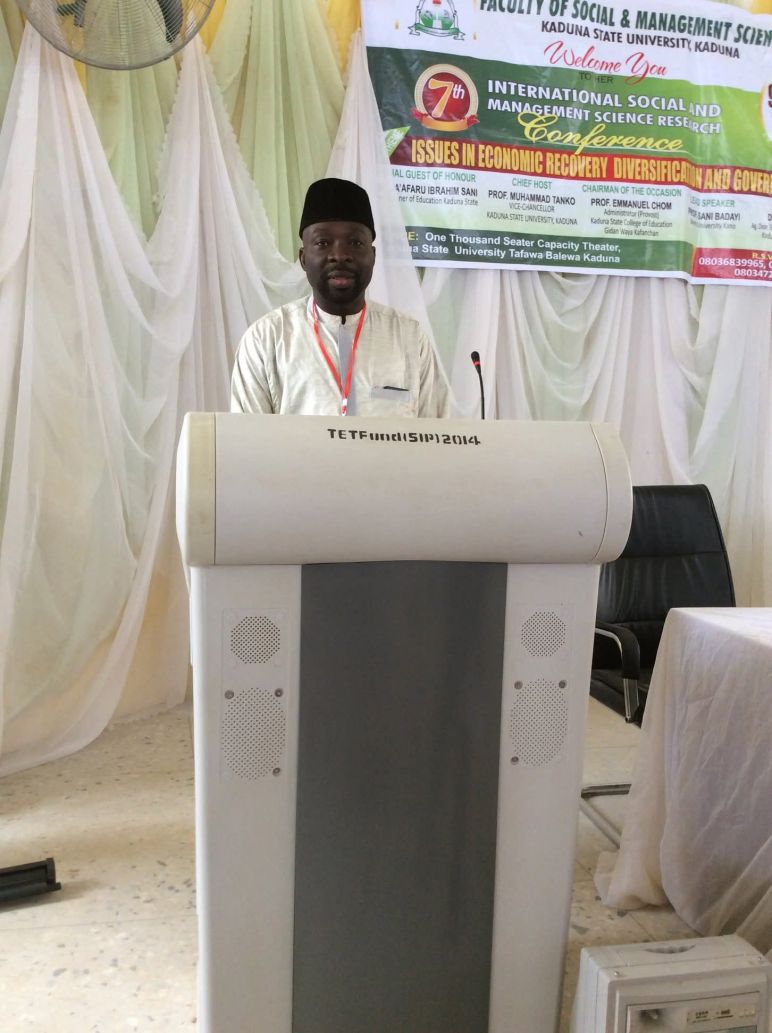
By Dr. Sulaiman Abdulwahab Sulaiman, CNA
This is a commentary based on the response by Mr. Tanimu Tancy to a post by Mallam Yusuf Galadima. The response reads “That’s your view but for me, it most never starts with the western zone always, I agreed zoning should go on but another zone can start but not automatically from the western zone. It should be neutral and every zone should contest, any one that wins the ticket then automatically zoning has started with them for fairness, equity and justice. And as you rightly said, I believe it will bring benefits to the state as a whole”. For proper understanding, this the earlier post by Mallam Yusuf Galadima. “In my view, selecting the APC’s 2027 governorship candidate from Nasarawa West is crucial for promoting justice, fairness, and unity in the state. It’s essential to give the region a fair chance to lead, ensuring balanced representation and fostering a sense of inclusivity. I firmly believe this decision would benefit Nasarawa State as a whole.
INTRODUCTION
Since both write-ups agree that zoning promotes unity, fairness and justice, the issue is already 50% resolved. The next step is to analyze where the remaining 50% lies. The main difference between the two positions is that one argues zoning should continue among alternatives, while the other contends it ends after the first round and can restart from any zone.
UNDERSTANDING ZONING
Zoning simply means rotation among alternatives with equal rights. In this context, the alternatives are the three senatorial zones of Nasarawa State—Western, Southern and Northern—while the subject of rotation is the governorship seat.
Before illustrating this with four real-life examples at the constituency, state and national levels, it is important to emphasize that zoning is continuous among alternatives. Zoning does not end after the first round and restart arbitrarily, except where unforeseen factors truncate the process. The following scenarios support this position.
AT THE CONSTITUENCY LEVEL (HOUSE OF REPRESENTATIVES)
Consciously or unconsciously, there has been a rotation of the House of Representatives seat among Doma, Awe and Keana Local Government Areas since 1999—until the Dr. Hashimu saga, when he contested for the Senate but eventually accepted the House of Representatives seat meant for Keana LGA. However, the three LGAs later corrected the imbalance, such that by 2027 the seat is expected to move to Awe LGA after Keana completes its turn.
According to the opposing view, zoning can start anywhere after the first round. But can we now say Keana LGA should again produce the next House of Representatives member for 2027–2035? The answer is clearly no—it must continue from where it began after going round.
AT THE STATE LEVEL (GOVERNORSHIP)
Similarly, at the state level, zoning began (whether consciously or not) with Senator Abdullahi Adamu from 1999 to 2007, followed by Alhaji Aliyu Akwe Doma (May his soul rest in peace) from 2007 to 2011. Senator Tanko Al-Makura then governed for eight years (2011–2019) after defeating the PDP government.
Notably, both Alhaji Doma and Senator Al-Makura hail from the Southern Zone, which led to that zone ruling for twelve years—an outcome of political coincidence rather than design. What matters is that zoning continued with the Southern Zone. Thereafter, the Akwanga Zone (Northern Zone) produced the current governor, His Excellency Engr. A. A. Sule (2019–2027, Insha Allah).
This means the three zones have completed a round of rotation. Now, if we adopt the view that zoning can start anywhere after the first round—but not with the Western Zone—should Akwanga Zone produce another governor for 2027–2035? Again, the answer is no because zoning must continue from where it started after completing the round.
Hence, zoning does not stop after one round; it continues indefinitely unless interrupted by unforeseen events such as death, political upheaval, or party realignment.
AT THE FEDERAL LEVEL (PRESIDENCY UNDER PDP)
During the PDP era, the presidency rotated between the North and the South. President Obasanjo (1999–2007) represented the South, followed by President Yar’Adua (North) who served about three years before his death and President Jonathan (South) who completed the term, won in 2011, but lost to President Buhari in 2015.
If zoning could start anywhere after the first round, would President Jonathan have handed over to another Southerner in 2015, simply because the first round was completed? Obviously not. It had to return to the North to maintain the rotation principle. Therefore, rotation does not stop after one round—it continues unless truncated by extraordinary circumstances.
AT THE FEDERAL LEVEL (PRESIDENCY UNDER APC)
Under the APC, President Buhari served for eight years (2015–2023) from the North and now President Bola Ahmed Tinubu, from the South, is serving his first term and, Insha Allah, will complete his second term by 2031.
This represents a balanced round—eight years North, eight years South—under the same party. Can President Tinubu then anoint another Southerner in 2031 simply because the first round is complete? The answer remains no because zoning must continue where it began.
SUMMARY OF THE FOUR SCENARIOS
From the four examples above, it is evident that zoning—whether deliberate or incidental—is a continuous process. It does not end after the first or any round. What disrupts an agreed zoning arrangement are unforeseen factors or political variables, such as:
• The Dr. Hashimu saga (accepting a seat not originally contested for)
• Senator Al-Makura’s emergence from a different political party (CPC)
• President Yar’Adua’s untimely death abruptly altered the zoning balance
• President Buahri defeating President Jonathan
These exceptions prove that zoning continues unless interrupted by major external factors.
THE CURRENT CONTEXT IN NASARAWA STATE
Like their predecessors, both Senator Abdullahi Adamu and Senator Al-Makura influenced their successors. Similarly, Governor A. A. Sule will determine his successor. In his TVC interview, Governor Sule clearly stated that the next governor should come from the Western Zone of Nasarawa State, Insha Allah. This implies his intention to uphold the zoning tradition.
Therefore, aspirants from the Northern and Southern Zones who hope to secure the APC governorship ticket in 2027 are, by implication, “excluded” from consideration—though they still have the constitutional right to contest the primaries. However, they are unlikely to enjoy the party’s backing or that of Governor A. A. Sule, who remains the key determinant of political succession in the state.
AVAILABLE OPTIONS FOR OTHER ASPIRANTS
For aspirants from the Northern and Southern Zones who may not succeed in the APC primaries, three options exist:
- Remain in the APC as loyal stakeholders. This is the wisest path. The 2019 primaries are a good example—aspirants who contested with Engr. A. A. Sule remained in the APC and became party stakeholders.
- Remain in the APC but engage in anti-party activities. This is risky, as the party can discipline, suspend, or expel members found guilty of such actions.
- Defect to another party to contest again. While legally permissible, this option carries significant political risks. Competing against the ruling party’s candidate—backed by the incumbent—is an uphill battle. For instance, the late Senator Ewuga left the PDP for the APP in 2007 to pursue his governorship ambition but faced immense challenges. I am not unmindful of Senator Almakura defeating Alhaji Aliyu Doma the incumbent. The circumstances of 2011 and the present situation are completely different. That is a topic for another day.
CONCLUSION
Empirical evidence and historical records show that zoning has always been continuous—it does not end after the first or second round. It is now clear that the APC leader in Nasarawa State, Governor A. A. Sule, is determined to support a governorship candidate from the Western Zone in 2027. Finally, aspirants who do not make it through the primaries have several options:
• Remain in the APC for a better tomorrow;
• Remain in the APC but risk anti-party sanctions; or
• Move to another party to contest and face the real meaning of opposition.
As the Hausa proverb says, “Kowa yaja ruwa, shi ruwa kan daka” (He who draws water is the one who stirs it) and “Gani gawani yaisa wanni tsoron Allah” (Seeing others’ experiences should inspire the fear of God).
Dr. Sulaiman Abdulwahab Sulaiman, CNA
Former, Executive Secretary,
Nasarawa State Scholarship Board.
 nasarawaeye.com