
By Rayyanu Bala
The mega rally held yesterday in Lafia in support of President Bola Ahmed Tinubu and Governor Abdullahi Sule offered more than a show of political strength; it provided what many observers interpret as a glimpse into the likely direction of power transition in Nasarawa State.
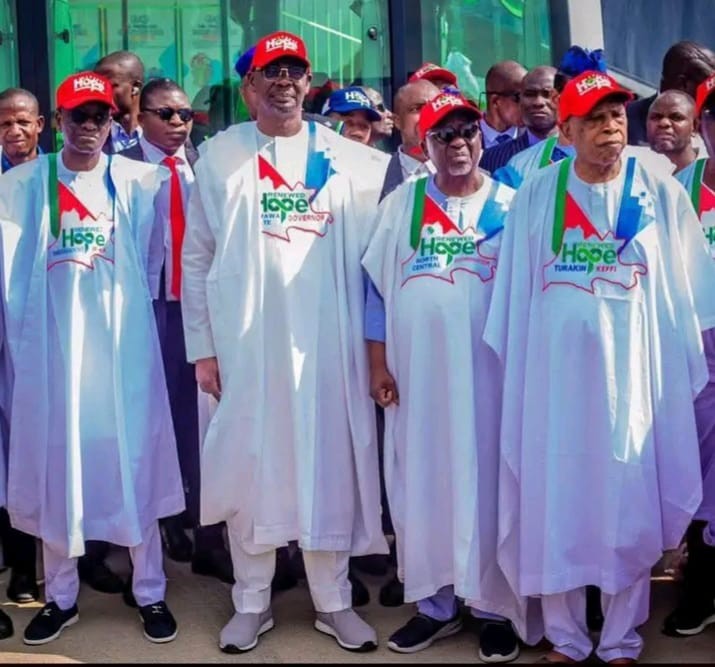
Politics in Nasarawa has always followed a distinctive rhythm, a blend of history, shifting alliances, zoning considerations, and what many simply describe as destiny. Immediately after the rally, a widely circulated photograph began making the rounds. To some, it was merely a gathering of influential political figures. To others, it appeared to represent a carefully aligned transition timeline:
Abdullahi Adamu (1999–2007)
Umaru Tanko Al-Makura (2011–2019)
Abdullahi Sule (2019–2027)
Ahmed Wadada Aliyu (2027–2035)
At first glance, the image may seem like a routine political snapshot. However, to keen observers of Nasarawa politics, the lineup speaks volumes. It reflects what many perceive as the natural, perhaps even divinely ordained succession of leadership in the state.
Abdullahi Adamu (1999–2007)
As the first elected executive governor of Nasarawa State in 1999, Abdullahi Adamu laid the political foundation at the dawn of Nigeria’s Fourth Republic. His administration symbolized the birth of democratic consolidation in the state. For many, his era represents the beginning of structured governance and the early formation of political alignments that continue to shape today’s realities.
Umaru Tanko Al-Makura (2011–2019)
Following a different political chapter between 2007 and 2011, Umaru Tanko Al-Makura’s emergence marked another defining period. His administration is widely remembered for its infrastructure projects and political dexterity, reinforcing the evolving power dynamics within the state.
Abdullahi Sule (2019–2027)
Governor Abdullahi Sule’s tenure, which began in 2019, ushered in what many describe as a technocratic and investment-driven approach to governance. With a strong business background, his leadership style emphasizes development, industrialization, and economic growth, continuing the unfolding political narrative of Nasarawa State.
Projected next in the sequence is Senator Ahmed Wadada Aliyu, whose supporters envision him serving from 2027 to 2035. For them, this is not mere speculation but a continuation of a quietly structured and consistently maintained power-sharing understanding in the state.
The lineup, therefore, represents more than a photograph, it symbolizes a political sequence.
In Nigerian politics, leadership often emerges from negotiated understandings, strategic alliances, and zonal balancing. To those familiar with Nasarawa’s political landscape, the alignment seen in the rally image appears deliberate rather than coincidental. It suggests continuity. It suggests consensus. It suggests order.
More significantly, it suggests inevitability, at least in the eyes of its supporters.
Many believe the governorship of Nasarawa State will follow this exact sequence: Abdullahi Adamu laying the foundation, followed by Al-Makura, then Sule, and by the special grace of God, Ahmed Wadada Aliyu assuming leadership from 2027 to 2035.
Undoubtedly, politics involves campaigns, party primaries, and electoral contests. Yet history in Nasarawa State suggests that when a political structure becomes firmly established, it often unfolds accordingly.
Beyond political calculations, some citizens interpret this anticipated transition within a spiritual framework. In their view, leadership is ultimately ordained by God. While individuals may strategize, negotiate, and campaign, divine will prevails.
The rally image, therefore, stands not just as a gallery of past and present leaders, but as a symbolic roadmap of Nasarawa State’s political journey which time will ultimately confirm.
 nasarawaeye.com