
By Rayyanu Bala
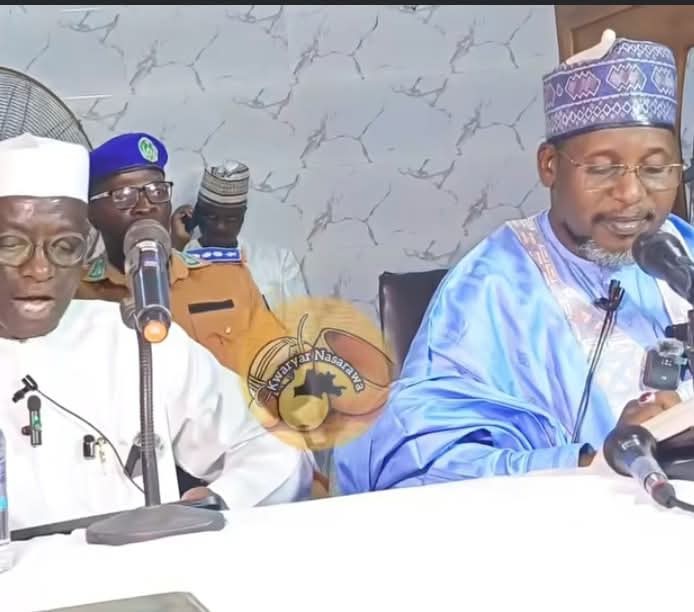
On a calm evening last Sunday in Keffi, at the Izala Central Jumu’at Mosque in the Low-Cost area, something striking happened. What really happened was that Senator Ahmad Wadada Aliyu attended the Ramadan Tafsir not as a listener or a political figure appearing only to register a presence as some politicians are fond of doing. Wadada at said tafsir, performed the role of Alaramma who reads the Qur’an for the leader of the tafsir to interpret. In short, Wadada sat and fully immersed himself in the spiritual moment, reading and engaging with the Qur’anic exegesis, reminiscent of his old days.
Anyone who knows Wadada knows him with deep knowledge of scripture and he is well versed in Qur’anic recitation. He understands the rhythm, the tajwid, and more importantly, the message. He does not merely quote verses; he interprets them within the context of justice, compassion, and responsibility. But what makes his story even more compelling in a diverse state like Nasarawa is that he is also well grounded in the Bible. He reads it. He understands it. And he respects its doctrine.
Nasarawa state, of course, is a state where Muslims and Christians live side by side peacefully and interact socially as if they shared the same faith.
Ahmad Wadada Aliyu is of course, the kind of leader, the state truly needs at this time.
Nasarawa state does not just need a politician, It needs a bridge-builder and a person who understands the doctrine of both religions. Just the way Engr. Abdullahi Sule also understands the doctrine of Christianity having attended a mission school.
Wadada’s public life has shown a pattern: he does not discriminate based on religion or tribe. In fact, many of those who have benefited most from his interventions such as scholarships, empowerment programs, community projects are not from his faith. This however reflects his mindset shaped by both the Qur’an and the Bible. Wadada knows very well that leadership is stewardship, and stewardship demands fairness.
In Nigeria, religion is often used as a political weapon. But Wadada is a leader who understands both Islam and Christianity not for convenience, but for conviction. He’s a leader who reads the Qur’an and sees accountability before God. He’s a leader who reads the Bible and sees the call to love one’s neighbour. He’s a leader who knows that governance, at its core, is service. Wadada is a leader for all not for a section.
When he sat comfortably and played the role of Alarama at the Ramadan Tafsir in Keffi, he indeed, reflected a man comfortable in his faith, yet respectful and knowledgeable about another. In a plural society like Nasarawa state, a home to diverse ethnic groups and denominations, such religious balance is not just admirable but it is necessary.
As the governorship election approaches, voters should ask themselves: what kind of leader do we want? Is it one who divides for political gain? Or one who understands that faith should unite the people not separate them?
Nasarawa needs a leader in the person of Wadada who can walk into a mosque and be at home and walk into a church and be equally grounded. Wadada is a leader who does not see a tribe or religion before seeing humanity. Wadada is a leader who measures success not by who shares his beliefs, but by how many lives he improves.
From all angles, Wadada represents that blend, spiritual depth, intellectual understanding of both major faiths, and a record of inclusive intervention.
At this critical stage of our development, Nasarawa deserves a leader in the person of Wadada who knows how to douse tension. Nasarawa deserves a leader in the person of Wadada who is calm and capable of navigating Nasarawa’s terrain justly and fearly.
Nasarawa deserves a trustful leader in the person of Wadada who raises leadership above narrow interests, Nasarawa deserves a leader in the person of Wadada who reads, understands, and lives by the doctrine of justice whether from the Qur’an or the Bible.
Wadada is indeed, the kind of a leader Nasarawa state truly needs at this critical time.
 nasarawaeye.com