
 By Ibrahim Habu Suleiman
Reactions to the postponement of elections earlier scheduled for February 16 have continued since the news began trickling in the early hours of D-day. The effect of the postponement on the population across the country was monumental judging from assurances the national electoral body had continuously given the entire country almost on a daily basis and the fact that the announcement did not come until just about five hours to the opening of the polls across the country.
Moreover the APC-led administration headed by President Muhammadu Buhari made certain that the Independent National Electoral Commission, INEC was adequately funded as and when due. In fact, the entire population has been duly mobilised towards exercising their civic duties. To this many folks had traveled out to their homes where they could eventually cast their votes; they include those Nigerians travelling from the southern to the northern parts of the country or vice versa. By the eve of the earlier scheduled date, the entire country was well-nigh prepared for the next day.
In Nasarawa State, the streets of Lafia, the state capital were agog with people seen moving up and down in high spirits. It was apparently clear that many more folks were trooping in from other towns and cities. Almost all government ministries and agencies were partially vacant, looking like they were being cleaned out. Government activities were at a standstill. Any group or crowd you met was busy discussing the forthcoming presidential and national assembly elections. Indeed, people were particularly focussed about the two presidential candidates of the ruling APC and the opposition PDP – President Muhammadu Buhari and Atiku Abubakar respectively. While most people spoke glowing attributes of the president Muhammadu Buhari, as a man of his words, an incorruptible man with high integrity and therefore worthy of being voted in for a second tenure, others preferred the former vice president Atiku Abubakar, who has been campaigning on the basis of atikulating the country better. It was the eve of the presidential and national assembly elections as it was earlier scheduled for February, 16 (now rescheduled for February, 23).
The general atmosphere on this day was that of feasting and junketing, perhaps akin to a Christmas or Sallah eve as the case may be. Hence, ordinarily you would wonder, why was no word passed somehow through the conservative or social media by government that Friday 15 the eve of the elections would be workfree? This would not only have allowed workers in government employment to travel out to wherever they would be casting their votes, but also for all others who would otherwise have business at the government offices to stay away and protect themselves from being harassed by heavily armed security officers at the gates of some these government offices.
At any rate, the whole of this Friday remained calm here in Lafia until somehow towards evening when the overcrowded streets began to take shape with new flashy electronic billboards in some junctions and roundabouts within the state capital, particularly at the Total Filling Station junction/roundabout where a particular billboard displayed the cheerful portraits of our amiable President Muhammadu Buhari in electronic film clips. People gathered briefly around this billboard, but many others swarmed across to their various activities in different directions.
It was also a day when many people kept themselves busy getting their voter cards ready against the forthcoming elections – the next day, as earlier scheduled. The talk of the general elections was everywhere. In mosques, churches, imams and pastors delivered sermons with the general election as the main theme. Generally, they prayed for peace to prevail before, during and after the elections. But, there were cases when some of the religious leaders insisted on guiding their members on who to vote for. In fact, the religious leaders mainly called on their members to vote in people with integrity, to vote in leaders who would protect their interests and not those who would afterwards only enrich themselves, their kith and kins. Others went as far as calling on believers to vote for a particular presidential candidate.
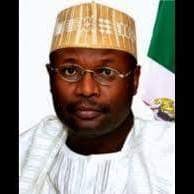
By nightfall, most of the population across the whole country was still feverish about the forthcoming general elections. Many people who went to bed early had the singular thought about the general election as they slept. It was therefore with the utmost amazement that the news of the postponement of the election was received by the generality of the population across the country. In fact many would not just believe it until they heard and saw for themselves as they say, from the horse’s mouth. The national chairman of INEC, Professor Mahmud Yakubu announced the postponement of the general elections by one week, with just about five hours left to the commencement of voting across the country. He said the decision of INEC was a difficult one, but necessary in order to have free, fair and credible elections. The general question has been, why now? Why should the Independent National Electoral Commission, INEC only announce the postponement just hours to D-Day?
Of course, many groups and individuals, including leading politicians from the biggest of the political parties in the country, were not only disappointed by the action of INEC, but also angry that it came at such a short notice. The ruling APC did not hide its disappointment as the party roundly condemned INEC, saying that with all the assurances regularly offered by the electoral body of its readiness to conduct the elections as scheduled, coupled with the fact that all necessary funds were duly made available to the commission by the presidency, it was still difficult to fathom where things most have gone wrong. President Muhammadu Buhari also condemned the commission for such an unwholesome act which after providing them with all the funding required for the general exercise it still came out to announce a postponement.
Indeed, this action by INEC has ignited a fresh avenue for political parties to get at each other. Hence, the APC likened the postponement to PDP’s age-old antics, as there were postponements in 2011 and 2015 that lasted much longer during the last PDP administrations, saying the opposition party was at it again, because it has lost all hope of winning the election squarely. But the PDP hit back at the APC alleging that all along it had pointed out there is a grand design by the ruling party to rig the elections. The presidential candidate of the opposition PDP, Atiku Abubakar in his reaction accused the ruling APC of colluding with the electoral body to disenfranchise the electorate so as to pave the way for APC to rig the election. However, as the recriminations and counter recriminations persisted, INEC further came out with more explanation as to why it postponed the polls. According to the Chairman of the national electoral agency, Professor Yakubu, the commission took the painful decision because of its determination to give Nigerians open, transparent and credible exercise. The decision was simply the sole responsibility of the commission. Thus, while promising Nigerians that the commission would do its utmost to ensure the elections are conducted freely, fairly and credibly, Yakubu reassured that the postponement had ‘nothing to do with politicians, nothing to do with any outside influence and nothing to do with (lack of) funding.’
However, reactions to the postponement continued to trail the announcement. The huge financial implications involved both to the electorate and the commission as well as international observers who had flown in from other African, European and American countries could threaten the eventual results of the elections. Millions of the electorate that had traveled to their respective homes for the exercise were dismayed to learn that they must repeat the same journey next week if they want to exercise their civic duties on the rescheduled date. This may result in what many observers had feared – disenfranchising millions of the electorate, particularly those hitherto on the fence, to turn away from the exercise completely due to lack of confidence in the preparations by the commission -serious aparthy. It was not surprising that Mahmud Yakubu ended up pleading to Nigerians and the international community for understanding to enable the commission to succeed.
As a matter of fact, experts have advised that both INEC and politicians should join forces to intensify awareness campaigns on the masses of the electorate assuring them on the readiness and preparedness of the electoral body and that the delay was only a result of unforeseen circumstances, and that everything would ultimately be taken care of to pave way for free, fair and credible elections on the rescheduled dates. Above all, it is expected that INEC would have learned its lessons from this and similar cases in the past not to allow any such postponements to occur again.Election Postponement, INEC and the rest of us
By Ibrahim Habu Suleiman
Reactions to the postponement of elections earlier scheduled for February 16 have continued since the news began trickling in the early hours of D-day. The effect of the postponement on the population across the country was monumental judging from assurances the national electoral body had continuously given the entire country almost on a daily basis and the fact that the announcement did not come until just about five hours to the opening of the polls across the country.
Moreover the APC-led administration headed by President Muhammadu Buhari made certain that the Independent National Electoral Commission, INEC was adequately funded as and when due. In fact, the entire population has been duly mobilised towards exercising their civic duties. To this many folks had traveled out to their homes where they could eventually cast their votes; they include those Nigerians travelling from the southern to the northern parts of the country or vice versa. By the eve of the earlier scheduled date, the entire country was well-nigh prepared for the next day.
In Nasarawa State, the streets of Lafia, the state capital were agog with people seen moving up and down in high spirits. It was apparently clear that many more folks were trooping in from other towns and cities. Almost all government ministries and agencies were partially vacant, looking like they were being cleaned out. Government activities were at a standstill. Any group or crowd you met was busy discussing the forthcoming presidential and national assembly elections. Indeed, people were particularly focussed about the two presidential candidates of the ruling APC and the opposition PDP – President Muhammadu Buhari and Atiku Abubakar respectively. While most people spoke glowing attributes of the president Muhammadu Buhari, as a man of his words, an incorruptible man with high integrity and therefore worthy of being voted in for a second tenure, others preferred the former vice president Atiku Abubakar, who has been campaigning on the basis of atikulating the country better. It was the eve of the presidential and national assembly elections as it was earlier scheduled for February, 16 (now rescheduled for February, 23).
The general atmosphere on this day was that of feasting and junketing, perhaps akin to a Christmas or Sallah eve as the case may be. Hence, ordinarily you would wonder, why was no word passed somehow through the conservative or social media by government that Friday 15 the eve of the elections would be workfree? This would not only have allowed workers in government employment to travel out to wherever they would be casting their votes, but also for all others who would otherwise have business at the government offices to stay away and protect themselves from being harassed by heavily armed security officers at the gates of some these government offices.
At any rate, the whole of this Friday remained calm here in Lafia until somehow towards evening when the overcrowded streets began to take shape with new flashy electronic billboards in some junctions and roundabouts within the state capital, particularly at the Total Filling Station junction/roundabout where a particular billboard displayed the cheerful portraits of our amiable President Muhammadu Buhari in electronic film clips. People gathered briefly around this billboard, but many others swarmed across to their various activities in different directions.
It was also a day when many people kept themselves busy getting their voter cards ready against the forthcoming elections – the next day, as earlier scheduled. The talk of the general elections was everywhere. In mosques, churches, imams and pastors delivered sermons with the general election as the main theme. Generally, they prayed for peace to prevail before, during and after the elections. But, there were cases when some of the religious leaders insisted on guiding their members on who to vote for. In fact, the religious leaders mainly called on their members to vote in people with integrity, to vote in leaders who would protect their interests and not those who would afterwards only enrich themselves, their kith and kins. Others went as far as calling on believers to vote for a particular presidential candidate.
By nightfall, most of the population across the whole country was still feverish about the forthcoming general elections. Many people who went to bed early had the singular thought about the general election as they slept. It was therefore with the utmost amazement that the news of the postponement of the election was received by the generality of the population across the country. In fact many would not just believe it until they heard and saw for themselves as they say, from the horse’s mouth. The national chairman of INEC, Professor Mahmud Yakubu announced the postponement of the general elections by one week, with just about five hours left to the commencement of voting across the country. He said the decision of INEC was a difficult one, but necessary in order to have free, fair and credible elections. The general question has been, why now? Why should the Independent National Electoral Commission, INEC only announce the postponement just hours to D-Day?
Of course, many groups and individuals, including leading politicians from the biggest of the political parties in the country, were not only disappointed by the action of INEC, but also angry that it came at such a short notice. The ruling APC did not hide its disappointment as the party roundly condemned INEC, saying that with all the assurances regularly offered by the electoral body of its readiness to conduct the elections as scheduled, coupled with the fact that all necessary funds were duly made available to the commission by the presidency, it was still difficult to fathom where things most have gone wrong. President Muhammadu Buhari also condemned the commission for such an unwholesome act which after providing them with all the funding required for the general exercise it still came out to announce a postponement.
Indeed, this action by INEC has ignited a fresh avenue for political parties to get at each other. Hence, the APC likened the postponement to PDP’s age-old antics, as there were postponements in 2011 and 2015 that lasted much longer during the last PDP administrations, saying the opposition party was at it again, because it has lost all hope of winning the election squarely. But the PDP hit back at the APC alleging that all along it had pointed out there is a grand design by the ruling party to rig the elections. The presidential candidate of the opposition PDP, Atiku Abubakar in his reaction accused the ruling APC of colluding with the electoral body to disenfranchise the electorate so as to pave the way for APC to rig the election. However, as the recriminations and counter recriminations persisted, INEC further came out with more explanation as to why it postponed the polls. According to the Chairman of the national electoral agency, Professor Yakubu, the commission took the painful decision because of its determination to give Nigerians open, transparent and credible exercise. The decision was simply the sole responsibility of the commission. Thus, while promising Nigerians that the commission would do its utmost to ensure the elections are conducted freely, fairly and credibly, Yakubu reassured that the postponement had ‘nothing to do with politicians, nothing to do with any outside influence and nothing to do with (lack of) funding.’
However, reactions to the postponement continued to trail the announcement. The huge financial implications involved both to the electorate and the commission as well as international observers who had flown in from other African, European and American countries could threaten the eventual results of the elections. Millions of the electorate that had traveled to their respective homes for the exercise were dismayed to learn that they must repeat the same journey next week if they want to exercise their civic duties on the rescheduled date. This may result in what many observers had feared – disenfranchising millions of the electorate, particularly those hitherto on the fence, to turn away from the exercise completely due to lack of confidence in the preparations by the commission -serious aparthy. It was not surprising that Mahmud Yakubu ended up pleading to Nigerians and the international community for understanding to enable the commission to succeed.
As a matter of fact, experts have advised that both INEC and politicians should join forces to intensify awareness campaigns on the masses of the electorate assuring them on the readiness and preparedness of the electoral body and that the delay was only a result of unforeseen circumstances, and that everything would ultimately be taken care of to pave way for free, fair and credible elections on the rescheduled dates. Above all, it is expected that INEC would have learned its lessons from this and similar cases in the past not to allow any such postponements to occur again.

