By Sumaila Isah Umaisha
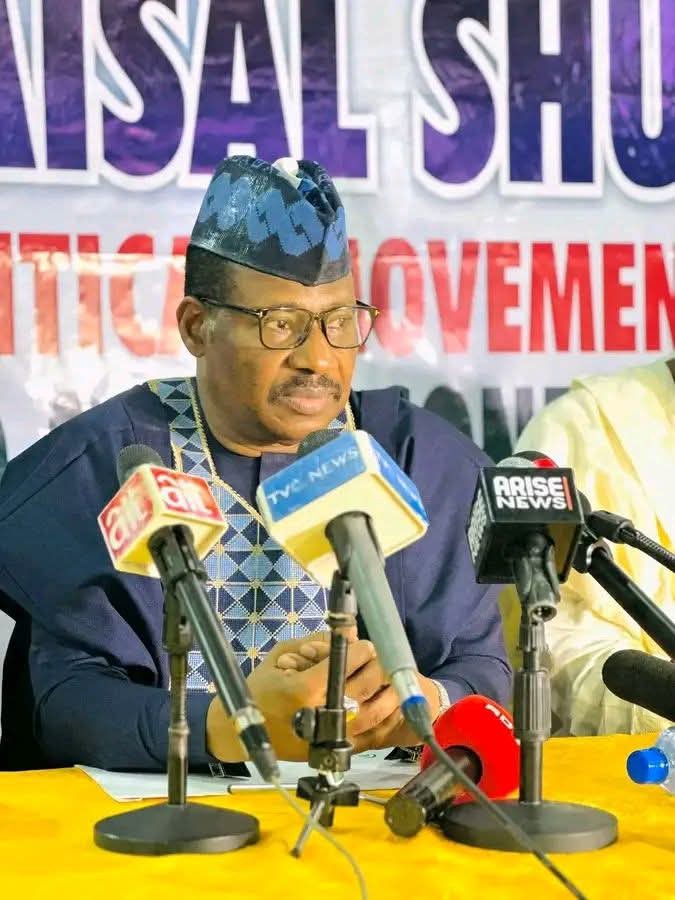
My immediate reaction to Dr. Faisal Shuaib’s address announcing his decision to step down from the Nasarawa State gubernatorial race was: “This is a great speech and wise decision from the man who knows that every detour is only part of the journey to the final destination!” The words were spontaneous, coming directly from the very depth of my heart because in a political climate often characterised by defiance and prolonged disputes fired by greed and personal ambition, the decision stands out as a monumental act of courage and selflessness.
While many expressed surprise at his choice, I did not. Having served under his leadership at the National Primary Health Care Development Agency, I am well acquainted with his temperament and decision-making style. I have seen, repeatedly, his capacity to act decisively in moments of urgency while maintaining a steady commitment to wisdom and restraint. Where others might escalate tensions, he consistently opts for measured responses that de-escalate and stabilise.
Viewed in this light, his withdrawal, following the emergence of Senator Ahmed Aliyu Wadada as the preferred candidate of Governor Abdullahi A. Sule, is more than a political calculation. It is a reflection of deeply held values: integrity, discipline, and a long-term vision that places collective progress above personal ambition. By this decision Dr. Shuaib has proved beyond doubt that he is a man of his words; a principle rarely practised in Nigerian politics. He had committed to support the consensus choice of the party leadership. And when the moment came, difficult as it was, he honoured that commitment. By keeping his word under pressure, he has reinforced the credibility not just of himself, but of the democratic process within the All Progressives Congress. In doing so, he has set a precedent that agreements reached in good faith must be upheld even when inconvenient. He has shown that politics, at its best, is not a theatre of ego but a system of trust.
Despite my spontaneous admiration upon hearing the decision, there was an undeniable sense of sadness beneath it, one I believe many of his supporters share. Indeed, some have openly expressed their frustration, which is only natural. Political aspirations are seldom solitary pursuits; they are shared dreams carried by a collective. For many who have invested their time, energy, and personal resources into his campaign, this moment is understandably difficult. The disappointment is real.
Yet, it is precisely at such moments that leadership rises above personal ambition. Dr. Shuaib’s appeal for calm, unity, and sustained commitment to the party’s progress is both timely and necessary. Political maturity is not measured solely by victory, but by the grace and clarity with which one responds to setbacks. Rather than dwell in discontent, there is a need to align with the broader purpose. The journey may be longer than anticipated, but with patience and resolve, the cause itself remains intact.
Far from diminishing his political future, this decision may well enhance it. For a long-term politics, reputation is important. By stepping aside with dignity, Dr. Shuaib has positioned himself as a statesman. He has demonstrated loyalty to party structure, respect for leadership, and an ability to prioritise collective interest over personal gain. These are qualities that endure beyond elections. Political careers are not built only on victories at the polls. Within Nasarawa State, and indeed at the national level, such attributes are closely observed.
Beyond individual implications, this development carries significant weight for the political stability of Nasarawa State. Internal party conflicts have historically weakened electoral prospects and governance outcomes. By choosing the path of unity, Dr. Shuaib has contributed to a more cohesive political environment, in which the ruling party can approach the coming elections with a consolidated front.
This is advantageous for the APC, and beneficial for governance itself. A fractured political base often translates into distracted leadership. Unity, on the other hand, creates space for focus, policy continuity, and development.
Perhaps the most important takeaway from this episode is its potential to reshape expectations. Nigerian politics has long suffered from a deficit of graceful exits. Contests often devolve into prolonged disputes, legal battles, and factional splits. Dr. Shuaib’s approach has set a good example, an alternative model based on civility, discipline, and respect for process. If emulated, such conduct could gradually readjust the political culture, making room for a more principled and less adversarial system.
By and large, Dr. Faisal Shuaib’s withdrawal is not an end, but a transition. It reflects a leader who understands that service is not confined to a particular office, and that influence is not always exercised from the frontlines. In choosing the harder path of concession, he has strengthened both his personal standing and the political fabric of Nasarawa State. History often remembers not just those who win, but those who choose rightly when it matters most. And history does not just remember but rewards the patient with the ultimate goal. We shall get there eventually!
Sumaila Isah Umaisha, a veteran journalist, writes from Keffi.