
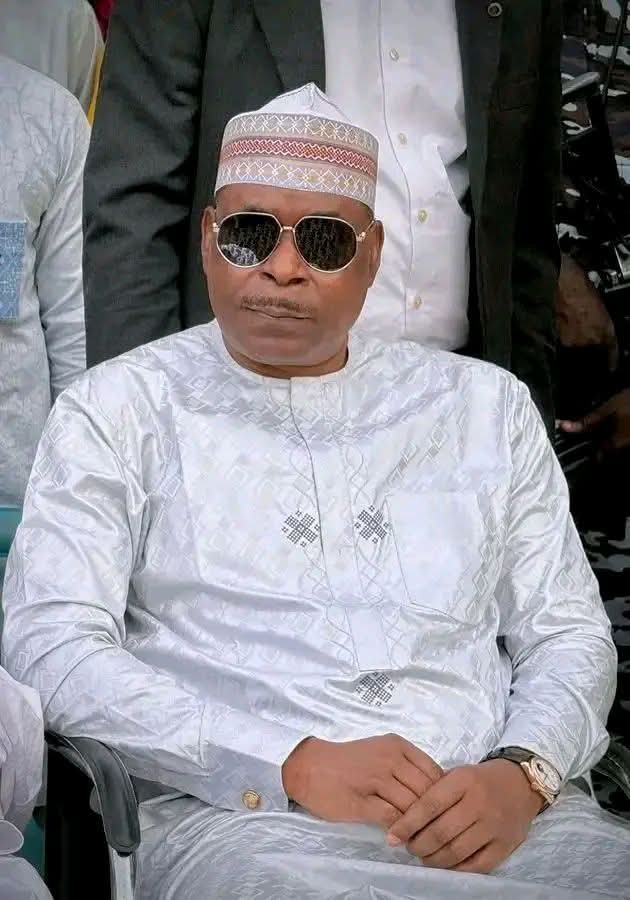
By Mohammed Kilema, Lafia
The statement attributed to former Inspector-General of Police, Mohammed Abubakar Adamu, at the SDP National Convention in Abuja—that “nobody needs the APC in Nasarawa State” and that “the people are tired of the APC”—deserves more than a casual political response. It deserves scrutiny, because it exposes a fundamental misunderstanding of democracy, political organisation and, perhaps most importantly, the difference between personal disappointment and popular rejection.
Let us begin with the obvious.
The former IGP contested for the APC gubernatorial ticket and lost. That is politics. He exercised his democratic right to seek the ticket; other aspirants exercised theirs; the party conducted its process; and a different political direction emerged. A mature politician accepts victory and defeat as two sides of the same democratic coin.
What is profoundly disappointing, however, is the apparent transformation of electoral disappointment into anger against the very political platform through which he sought to become Governor.
If the APC was unnecessary to Nasarawa State, why did “Adamu Lafia”, as he is fondly called by his mates, seek its gubernatorial ticket in the first place?
If the people were truly tired of the APC, why did he spend considerable political energy seeking to become the party’s candidate?
If the APC was irrelevant to the people, why did he believe its ticket was sufficiently valuable to pursue?
And if he genuinely believed the party had become unacceptable to Nasarawa voters, was it not intellectually more consistent to make that argument before seeking its ticket rather than after losing the contest for it?
These are not personal questions. They are questions of political consistency.
From “My Ticket” to “No APC”
There is a troubling pattern in Nigerian politics in which an aspirant embraces a political party when he believes its platform can deliver power to him, but immediately discovers that the same party is “finished”, “unwanted” or “rejected by the people” when the party’s decision does not favour him.
That is not political principle. It is political opportunism.
The APC cannot simultaneously be sufficiently attractive for Adamu to seek its gubernatorial ticket and sufficiently irrelevant for him to declare, after his defeat, that nobody needs it.
One cannot have it both ways.
If the former IGP has evidence that the people of Nasarawa State have rejected the APC, let him publish the evidence.
What opinion poll did he commission?
What scientifically conducted survey did he undertake?
Across what local governments?
With what sample size?
What methodology was employed?
What independent electoral evidence supports the assertion?
Who are the millions of Nasarawa citizens who supposedly authorised him to speak on their behalf?
Politics is not a police parade. It is not a command structure in which an officer speaks and everyone responds, “Yes, Sir!”
The Regimented Mindset and the Reality of Politics
This is perhaps where the former IGP needs to make the most important adjustment.
The Nigerian Police Force operates within a hierarchical and disciplined command structure. Orders are issued and subordinates are expected to obey within the limits of law and professional responsibility.
Politics is fundamentally different.
A politician does not command the people.
He persuades them.
He negotiates.
He consults.
He builds coalitions.
He listens.
He compromises.
He earns trust.
And ultimately, he submits himself to the judgement of voters.
The people of Nasarawa State are not police recruits awaiting instructions from a superior officer. They are citizens with independent political choices.
The former IGP may have commanded enormous institutional authority in his distinguished police career. But political authority cannot be inherited from a police rank. In politics, nobody is obliged to say “Yes, Sir.”
The ballot says yes or no.
That is why I would respectfully caution Adamu Lafia: mind your words.
A Political Newcomer Cannot Rewrite Nasarawa’s Political History
Another dimension cannot be ignored.
Adamu may be a giant in policing, but in partisan politics he is, frankly, non-age—a political newcomer still learning the terrain.
His distinguished career in the Nigeria Police Force is acknowledged and respected. But policing and politics are different disciplines.
The former IGP is therefore yet to demonstrate the depth of political experience required to make sweeping pronouncements about the collective political consciousness of Nasarawa State.
He is a dying giant—not a political giant.
His giant stature belongs to the institution he once headed. In partisan politics, however, he has yet to establish himself as a political force capable of speaking for the entire state.
The difference is crucial.
A police career can confer rank.
Politics demands relevance.
A police command can confer authority.
Politics requires acceptance.
A police order can produce immediate compliance.
Politics requires persuasion.
And What Exactly Is His Constituency?
There is another irony in the statement.
The former IGP reportedly speaks of his constituency and, by implication, the people upon whose behalf he claims to speak.
But let us be realistic.
The constituency he claims as his political base is, in substantial measure, our APC constituency.
These are the same communities, families, voters, traditional institutions and political networks that have constituted the APC’s support base in Nasarawa State.
One cannot appropriate the people when seeking their votes and disown the political structure through which those people have organised themselves when the structure does not produce one’s desired outcome.
The people are not anybody’s private political property.
Not Adamu’s.
Not Al-Makura’s.
Not Sule’s.
Not Wadada’s.
Not mine.
They belong to themselves.
And that is precisely why nobody should presume to speak for them without evidence.
The Al-Makura Dimension
Rayyanu Bala is therefore right to draw the attention of Senator Umaru Tanko Al-Makura to the statement.
Senator Al-Makura occupies an important position in the political architecture of the Renewed Hope project in the North-Central region. If a prominent former public officer publicly declares that the people of Nasarawa State are tired of the APC, the assertion naturally raises a question about the strength of the party and the Renewed Hope project in the state.
But I would go further.
The appropriate response is not merely for Al-Makura to defend the APC rhetorically. The APC itself should demonstrate its strength through organisation, mobilisation, grassroots engagement and ultimately electoral performance.
And that is precisely where Adamu’s assertion becomes vulnerable.
The APC does not require his permission to exist in Nasarawa State.
It does not require his endorsement to command support.
And it certainly does not cease to be relevant because an aspirant who sought its ticket did not secure it.
Consensus Is Not Rejection
The current debate also needs intellectual honesty.
The emergence of a preferred candidate through consultation and consensus does not automatically constitute imposition or anti-democratic practice.
Political parties everywhere engage in consultation, negotiation, coalition-building and consensus formation.
Indeed, the emergence of Senator Ahmed Aliyu Wadada as the preferred candidate through broad consultations is itself a political process designed to prevent fragmentation and maximise the party’s chances at the general election.
Those who disagree remain entitled to disagree.
But disagreement is not evidence of popular rejection.
Defeat is not evidence of conspiracy.
And personal disappointment is certainly not evidence that an entire state has rejected a political party.
The Challenge to Adamu
Therefore, I challenge the former IGP to substantiate his assertion.
Let him demonstrate, with credible evidence, that “nobody needs the APC in Nasarawa State.”
Let him produce the polling data.
Let him identify the methodology.
Let him demonstrate the statewide consultations.
Let him show the evidence from the 13 local government areas.
Let him establish that the statement represents the collective will of Nasarawa rather than the political frustration of an individual aspirant.
Until then, the declaration remains precisely what it appears to be: a political assertion without demonstrated empirical foundation.
And worse, it risks appearing to be the emotional reaction of a man who sought the APC ticket, failed to secure it, and subsequently turned his disappointment against the institution whose ticket he once considered desirable.
Nasarawa Is Bigger Than Any Aspirant
The former IGP should also remember that Nasarawa State is bigger than any individual ambition.
No aspirant owns Nasarawa.
No political office is hereditary.
No candidate is entitled to a party ticket.
And no defeated aspirant has the right to convert personal disappointment into a declaration on behalf of an entire people.
The people will decide.
The APC will organise.
The opposition will organise.
Candidates will campaign.
Citizens will listen.
And, ultimately, the ballot will speak.
That is democracy.
But until the ballot speaks, nobody should arrogate to himself the authority to announce what the people have decided.
Adamu Lafia may have commanded the police.
He cannot command Nasarawa.
He may have been accustomed to “Yes, Sir.”
Politics will give him something very different:
“We shall decide.”
And that, ultimately, is the sovereign right of the people.
Adamu, mind your words. Nasarawa is listening—and Nasarawa will decide.

